Sunday, 22 December 2013

The first day of Sciencemas

On the first day of Christmas, my scientist gave to me...
A beaker in a fume hood.

Saturday, 21 December 2013

BYO Death Ray: Get ready for the 'big slurp'

Our first BYO Dylan is back with a new story - the prospect of the universe collapsing on itself - possibly today!

Scientists from the University of Southern Denmark think that universe is about to implode, in what some are calling a 'Big Slurp'.

They say that something called a 'phase transition' may occur very soon. It has been "proven" (not really, but the Denmark scientists say they have proven it), that a "shift in the forces of the universe will cause every particle in it to become extremely heavy... essentially squeezing everything into an extremely hot, heavy, tiny ball", reports the Daily Mail.

A basic diagram of a 'phase transition'. Image from the University Of Denmark.

Wednesday, 18 December 2013

New species of tapir discovered in New York City!

Scientists have just described a new species of tapir from South America with the help of a one-hundred-year-old specimen from the American Natural History Museum in New York City.

In 1913, former US President Theodore Roosevelt was on an expedition to the Amazonian rainforest. He shot and killed a Tapir - for scientific purposes of course - and members of his party killed a few more - also for scientific purposes. One of those killed was a bit different to the others, and Roosevelt wrote at the time:
One was a bull, full grown but very much smaller than the animal I had killed. The hunters said that this was a distinct kind. The skull and skin were sent back with the other specimens to the American Museum, where after due examination and comparison its specific identity will be established.

Sunday, 15 December 2013

BYO Death Ray: Mount Burnett Observatory Young Observer's Night

Our newest correspondent, Magnus Bock, aged 12, has this special report from the historic Mount Burnett Observatory just outside of Melbourne, Australia.

Hello, I’m Magnus Bock, Senior Labrat and Mount Burnett Observatory Member and I’m here to tell you about what I do at Mount Burnett.

Observing sun spots reflected onto paper from a telescope
Magnus and the Mount Burnett dome
Mount Burnett is an Observatory in the Dandenong Ranges, near Cockatoo. It used to be run by Monash University, but they decommissioned it and it started to fall apart. In 2010 a group of locals and astronomically-minded people got together to restore it and make it work again. There is a big telescope in the dome and several portable Dobsonian telescopes for members to use.

Last night I went to Mount Burnett Observatory’s Young Observer’s night. It was really fun but sadly it was the last one of the year. Here are some of the things we did:
  • Had a picnic.
  • Looked at the sun and moon.
  • Normally we would also have a speaker, but not this week.
The aims of the Young Observers Group are:

BYO Death Ray: NASA predicts ozone hole recovery in 2070

Congratulations to our first ever BYO (Build Your Own) Death Ray contributor. 13-year-old Dylan from Balwyn High School in Melbourne has sent us some good news in science - the recovery of the ozone layer. He also wins an iTunes voucher.

New research from NASA claims that the ozone layer may fully recover in around 2070. This was announced at a presentation on Wednesday during the annual American Geophysical Union meeting in San Francisco.

The ozone layer over Antarctica.
The blue area is the 'hole'.
Image from NASA/Ozone Hole Watch.
It has been 26 years since the Montreal Protocol, which in 1997 led to 197 countries banning the chemicals that harm the ozone layer. Susan Strahan of NASA's Goddard Space Flight Center said that the harmful chemicals in the atmosphere are dropping because of the protocol but have not yet dropped to the point where the ozone layer will start sealing itself back up again. Right now, major events such as global warming and variations of temperature and wind are causing disruptions in the healing process of the ozone layer.

Friday, 13 December 2013

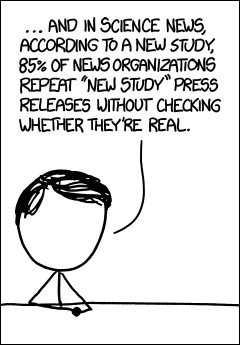
Science comic of the week: Science journalists are lazy and stupid... HEY, WHO SAID THAT!

I AM A SCIENCE JOURNALIST AND I AM NOT LAZY OR STUPID AND I... I FORGET WHERE I WAS GOING WITH THIS AND... OH, I CAN'T BE BOTHERED, I'M GOING TO HAVE A LIE DOWN.

Anyway, following on from our report earlier in the week about the GM paper that was widely reported in the media but turned out to be dodgy, this week's comic tells a sadly all too true tale.
xkcd.com
A lot of science that gets reported in the news turns out to be much less exciting than it is made out to be. The truth, when it is finally revealed, is often not interesting - or newsworthy - enough to make it into the news.

Wednesday, 11 December 2013

RETRACTED: When science rights a wrong

A widely criticised 2012 paper claiming that genetically modified (GM) corn causes cancer has been retracted.

A scientist's worst nightmare
Genetically modified organisms (GMOs) are organisms that have had their DNA changed in the laboratory, usually by adding some DNA from a different organism. The idea is to give the organism a special ability such as protection from insects, faster growth or healthier food, or to create some kind of half human, half animal monstrosity.

The retracted paper was published in the September 2012 edition of the journal Food and Chemical Toxicology and was written by a French professor named Gilles-Éric Séralini and his colleagues.

Dr Séralini studied NK103 corn (also called maize), which has been modified to protect it from a common herbicide (or weed killer) called glyphosate. Farmers growing this corn can spray their fields with glyphosate and all of the weeds will be killed, but the corn will survive.